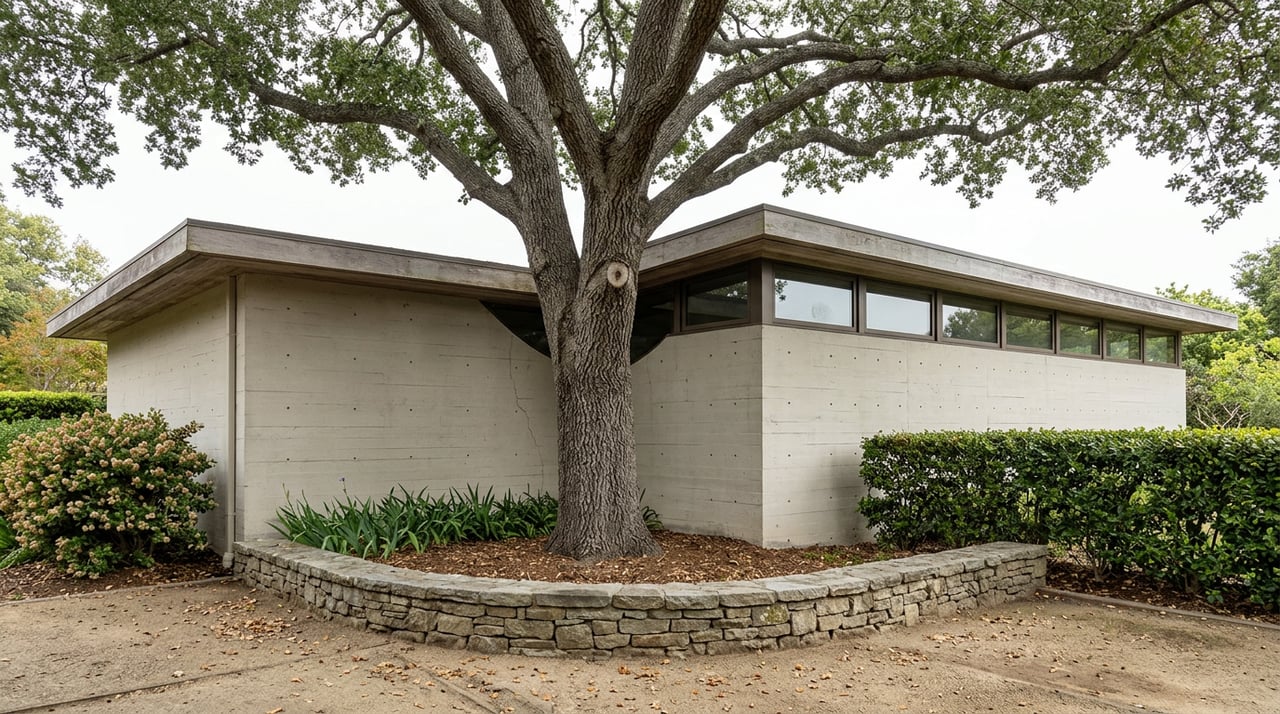
The property at 28 Selby Lane had already cleared its biggest hurdle. The old structures were down. The Town Arborist had signed off on removing eleven heritage trees deemed dead or dangerous. What remained was one healthy 26.6-inch incense cedar, standing in the spot where the new garage was supposed to go.
The Planning Commission staff report recommended denial. Not because the tree was rare or the site was small (the lot ran 1.7 acres, well past the town's one-acre minimum), but because the applicant could, in staff's professional opinion, put the garage somewhere else. One live tree, not scheduled for removal under any dead-or-dangerous exception, sent a fully demolished, fully cleared 1.7-acre project back to the drawing board over garage placement.
That case is the clearest illustration of a rule most Atherton sellers and renovators underestimate: the town's Heritage Tree Ordinance does not treat location the way almost every other zoning rule does.
Location Doesn't Save You If It's an Oak
Most development restrictions in Atherton, like most restrictions anywhere, care about where something sits. Setbacks matter. Lot coverage matters. Where a structure falls relative to the property line changes what you can and cannot build.
Chapter 8.10 of the Atherton Municipal Code splits that logic in two. A native oak of 48 inches or more in circumference (roughly 15.2 inches in diameter, measured 54 inches above grade) is protected anywhere on the lot, inside the buildable envelope or outside it. Every other tree species has to hit that same size threshold and sit outside the main buildable area to qualify for protection.
| Tree type | Protected inside buildable area? | Protected outside buildable area? |
|---|---|---|
| Native oak, 48"+ circumference | Yes | Yes |
| Other species, 48"+ circumference | No | Yes |
| Trees under 48" circumference | No | No |
That asymmetry is the part that catches people off guard. A homeowner who has confirmed their addition sits well inside the buildable footprint has, in most cases, cleared the tree question for anything that isn't an oak. If it is an oak, the footprint doesn't matter. The tree has to be dealt with on its own terms, through its own permit, on its own timeline.
The Clock Starts After the Plans Are Already Drawn
The problem isn't the rule itself. It's when most people encounter it.
Removing a protected tree that isn't dead or dangerous means an application to the Planning Commission, a $750 fee, and a hearing where the commission has to find that removal wouldn't run contrary to the intent of the General Plan before it can approve anything. Applicants can generally expect six to ten weeks between filing and a decision, longer if the request involves a variance or a more complicated site.
That window typically opens after a design is finished, not before. An architect draws around what looks like open ground, a contractor prices the job, and the tree survey required for the building permit submittal is often the point where the plan meets the ordinance for the first time. The town's own tree protection standards require a written arborist report identifying every heritage tree on site and within 15 feet of the property line before grading, demolition, or building permits can be issued, which means the discovery moment tends to land well into a project's timeline rather than at the start of it.
The town's enforcement stance leaves little room to argue the point after the fact. As one specialty guide to the ordinance puts it, "I thought it was dead is not a valid defense if the tree was a protected oak." Violations carry fines that can run into the thousands per tree, on top of restitution and replacement obligations.
The Line Item That Shows Up in the Second Quote
The cost of this discovery shows up most clearly in documented project numbers rather than in the ordinance text itself.
One 2026 ADU project in Atherton came in with two initial ballpark quotes, at $420,000 and $640,000. A site walkthrough turned up seven items missing from those numbers, and the tree-protection plan for two oaks within 25 feet of the build footprint was one of them, priced at $8,500. Alongside a separate water meter requirement, an accessibility upgrade, and additional trenching, the fixed-price contract landed at $562,000. Architectural Review Board approval took two hearings and roughly three months from submission, construction ran 41 working weeks, and the full span from signed contract to certificate of occupancy came to 16 months.
None of that is unusual for Atherton. It's close to the standard 3-to-8-month permitting window the town's own process typically requires for new construction, before any complications from heritage trees or variances stretch it further. What stands out is where the tree cost landed: not in the original estimate, but in the walkthrough that corrected it. A line item that size, discovered mid-process rather than budgeted from day one, is the kind of thing a seller or a buyer wants identified before an offer is written, not after a contractor's second quote arrives.
Timing It Against a Market That Moves in Weeks, Not Seasons
None of this happens in a market with room to wait.
In June 2026, Atherton had roughly ten homes on the market, translating to under one month of supply, with homes selling at a median of $10,950,000. Estimates of that median vary considerably depending on which data source you check, sometimes by tens of millions of dollars, largely because so few transactions close in any given month that one or two estate-level sales can swing the number on their own. Over the three months ending May 2026, the median sale price for closed transactions ran to $10.9 million, and homes were taking about 20 days to sell, up from 9 days the year before but still fast by any normal measure.
A market that thin doesn't leave much cushion for a six-to-ten-week Planning Commission process that nobody scheduled for. If a seller's pre-listing preparation surfaces a heritage oak sitting where a buyer's architect wants a pool house, or if a buyer's due diligence period runs out before an arborist report even lands, the ordinance stops being a landscaping detail and starts shaping the deal itself. The homeowners best positioned in this market are the ones who treat the tree survey the way they'd treat a title report: something pulled before the property goes live, not something discovered once escrow is already ticking.
Frequently Asked Questions
Does the ordinance apply to a tree that's already dead? Genuinely dead or hazardous heritage trees can be removed through a more direct process than a live, healthy one, but the town still requires documentation, notification, and in many cases a retroactive permit application rather than removal on sight.
Can I trim a protected oak without a permit? Routine pruning that follows standard arboricultural practice and removes a limited share of the live canopy generally doesn't require a permit, but anything that could be read as excessive, or any work inside a tree's protection zone during construction, falls under the same review as removal.
Does this only affect new construction, or remodels too? Every new construction, remodel, or demolition project on a lot with a heritage tree requires a tree protection plan submitted before permits are issued, regardless of whether the project is a full rebuild or a smaller addition.
Atherton's tree canopy is one of the things that makes the town what it is, and the ordinance exists to keep it that way. But knowing exactly where the line falls, oak versus not, inside the footprint versus outside it, before the plans are drawn is what keeps a renovation or a listing on schedule instead of in front of the Planning Commission.
If you're weighing a remodel, an ADU, or a sale on an Atherton lot with mature trees, Dana Rae Stone can help you get the right surveys and reports lined up before they become a surprise. Let's talk about your home.